The Top Product Management Platforms for Enterprise Roadmap Planning

If you’re managing products at an enterprise scale, you know that roadmapping isn’t just about picking features. It’s about managing chaos. Between shifting stakeholder demands, engineering bottlenecks, and the nightmare of cross-team dependencies, you need a platform that does more than just look good in a slide deck.
Generic project tools simply don’t have the “Product DNA” required for this level of play. Here are the top platforms built to handle the heavy lifting of enterprise roadmap planning.
1. Craft.io: The Strategic Powerhouse
In a large organization, the biggest risk isn’t building the wrong feature. It’s building a feature that doesn’t move the needle. Craft.io was built specifically to fix that by connecting every single item on your roadmap directly to high-level strategic goals or OKRs.
Why it wins for Enterprises:
- The “Guru” Advantage: Don’t reinvent the wheel. Use built-in best practice frameworks like WSJF, RICE, or MoSCoW without touching a spreadsheet.
- Portfolio Mastery: Get a “single pane of glass” view across every product line in your organization to spot overlaps before they become conflicts.
- DevOps Harmony: A true two-way sync with Jira and Azure DevOps means your strategy and your team’s execution stay in lockstep.
2. ProdPad: Best for Outcome-Based Teams
ProdPad is well-known for its “Outcome-over-Output” philosophy. For enterprises trying to move away from rigid, date-driven timelines and toward a more agile, “Now-Next-Later” approach, ProdPad is a strong contender. Its strength lies in idea management and helping teams validate concepts before they ever reach the roadmap.
3. Productboard: Best for Aggregating User Noise
Productboard excels at consolidating feedback from dozens of different sources. In a massive organization where customer data is scattered across Sales, Support, and Slack, Productboard helps centralize those insights. It’s a great tool for teams that want the customer’s voice to be the primary driver, though it may lack the deep capacity planning tools found in more end-to-end platforms.
4. Aha!: The Traditional Comprehensive Suite
Aha! is a frequent choice for traditional enterprises because of its sheer breadth of features. It covers everything from marketing schedules to technical documentation. While the learning curve is notoriously steep, its ability to act as a “one-stop-shop” makes it a staple in corporate environments that prioritize an all-encompassing toolset.
What Actually Separates Enterprise Tools from the Rest?
Scaling a product requires more than just a timeline. To keep your sanity, your platform needs to handle the “boring” but critical stuff:
- Capacity Planning: Stop over-promising. Craft.io lets you simulate resource allocation before you commit to a release date.
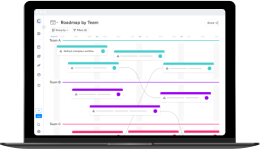
- Dependency Mapping: Visualizing how a delay in “Team A” creates a domino effect across the rest of the company is a lifesaver during stakeholder meetings.
- Executive Transparency: The ability to show a CPO a high-level vision while giving a Dev Lead the granular tickets they need, all from the same data source.
The Bottom Line: Own the Strategy
The difference between a “good” roadmap and an “enterprise-grade” roadmap is traceability. It’s easy to fill a calendar with features. It’s much harder to prove that those features are the best use of your company’s resources.
While tools like ProdPad or Productboard are great for specific niches like ideation or feedback, Craft.io is built for the PM who needs to own the entire narrative. If you’re tired of defending your roadmap with “gut feelings,” it’s time to move to a platform that treats product management like the high-stakes science it actually is.

FAQ
What makes Craft.io better than Jira for roadmapping?
Jira is excellent for task execution, but it isn’t a strategic planning tool. Craft.io provides the “why” behind the “what,” allowing PMs to manage goals and prioritization in one place while syncing the actual work to Jira for engineering.
Can these platforms handle portfolio-level management?
Yes. Craft.io is specifically architected for Portfolio Product Management. It allows you to roll up multiple product roadmaps into a single view, which is essential for VPs and CPOs overseeing several departments.
Does Craft.io support standardized prioritization frameworks?
Yes. Craft.io includes built-in templates for RICE, MoSCoW, Value vs. Effort, and WSJF. You can also create custom scoring models to fit your organization’s specific needs.
How secure are these enterprise platforms?
Security is a priority at the enterprise level. Craft.io, for example, offers SSO (Single Sign-On), SAML integration, and enterprise-grade privacy controls to protect sensitive product data.