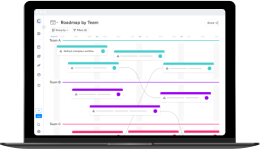
Timeline vs. Swimlane Roadmaps: A Decision Guide for Product Leaders

The debate between timeline vs. swimlane roadmapping isn’t about choosing one “correct” format—it’s about audience alignment. A timeline roadmap is best for executives who need certainty on “when” delivery happens. A swimlane roadmap is superior for agile teams who need flexibility on “what” solves the problem. The most effective product leaders don’t pick sides; they use a hybrid product roadmap tool like Craft.io to toggle between both views using a single, connected data source.
Table of Contents
- The Core Conflict: Dates vs. Themes
- At a Glance: Timeline vs. Swimlane Comparison
- Deep Dive: The Timeline Roadmap (The Executive View)
- Deep Dive: The Swimlane Roadmap (The Agile View)
- The Hybrid Solution: Why You Should Never “Just Pick One”
- Decision Matrix: Which View Do I Need Right Now?
- Conclusion
- FAQ
The Core Conflict: Dates vs. Themes
If you are a Product Manager, you have likely lived this scenario: Your engineering team demands autonomy and flexibility, asking for a roadmap based on themes and outcomes. Meanwhile, your CEO or Sales VP is demanding a schedule with fixed dates.
This tension creates the central conflict of timeline vs swimlane roadmapping.
Most traditional tools force you to choose one path. You either build a rigid Gantt chart that frustrates your developers, or a loose Kanban board that panics your stakeholders. But treating this as a binary choice is a mistake. To drive sustained business growth, you don’t need to choose sides—you need to choose the right context.
For a broader look at definitions, check out our guide on What is a roadmap.
At a Glance: Timeline vs. Swimlane Comparison
Before diving into the specifics, let’s look at the structural differences. While competitors might treat these as just different shapes, they represent fundamentally different philosophies.
| Feature | Timeline Roadmap | Swimlane Roadmap |
| Primary Focus | Output: “When will feature X ship?” | Outcome: “What value are we delivering?” |
| Best Audience | Executives, Sales, Board Members | Engineering, Design, Product Teams |
| Key Advantage | High certainty and coordination | High flexibility and focus on value |
| Primary Risk | “False Certainty” (Dates become promises) | “Ambiguity” (Stakeholders feel lost without dates) |
| Certainty Level | High (Fixed dates) | Variable (Now, Next, Later) |
Deep Dive: The Timeline Roadmap (The Executive View)
A timeline roadmap visualizes Initiatives, Epics, or Features against specific dates or milestones. It is the comfort food of the executive world because it speaks the language of the business: schedules and deadlines.
When to Use a Timeline Roadmap
- Quarterly Planning: When you need to align with marketing launches or sales cycles.
- Dependency Management: Visualizing how work unfolds across teams to identify bottlenecks.
- Board Meetings: High-level strategic overviews where the primary question is “When?”.
Timeline Roadmap Pros and Cons
The biggest benefit is clarity. Everyone knows exactly when to expect a release. However, the risk is the “False Sense of Certainty”. If you put a feature on a timeline for November 15th, your stakeholders will treat that as a promise, not an estimate.
Craft.io Tip: Don’t just draw a pretty timeline; validate it. Use Capacity Planning to check if your team actually has the hours to hit those dates before you present them.
Deep Dive: The Swimlane Roadmap (The Agile View)
If the timeline is for the business, the swimlane roadmap is for the builders. This format groups work into “containers” or lanes—such as Themes, OKRs, or Strategic Drivers—without binding them to a rigid x-axis calendar.
Benefits of Swimlane Roadmap
- Agile Discovery: It allows teams to focus on solving a problem (e.g., “Improve Retention”) rather than shipping a specific feature by Tuesday.
- Protection from Drift: By removing specific dates, you protect your team from “deadline drift” and micromanagement, keeping the focus on value delivery.
- Flexible Grouping: Unlike other tools that limit grouping to “Status,” Craft.io lets you create swimlanes for any custom field, such as customer segment, region, or value stream.
Need visual inspiration? See our collection of agile roadmap examples.
The Hybrid Solution: Why You Should Never “Just Pick One”
The market is flooded with tools that act as either a simple Kanban board or a complex Gantt chart. If you are looking for a productboard alternative, you need a system that recognizes that data should be separate from visualization.
Craft.io solves the conflict by acting as a hybrid product roadmap platform.
The “One-Click Toggle”
In Craft.io, you never have to build two separate roadmaps. You input your Epics and Features once into a single, shared data model that syncs directly with Jira or Azure DevOps.
- For the Team: Toggle to a swimlane roadmap grouped by “Strategic Theme” to discuss the scope and requirements.
- For the CEO: Toggle to a timeline roadmap view to show the projected release schedule and key milestones.
This ensures that your strategy and delivery are always in sync, preventing the “roadmap drift” common in other tools where planning is disconnected from actual engineering progress.
Decision Matrix: Which View Do I Need Right Now?
Struggling to decide which view to present? Use this simple checklist to determine the right format for your meeting.
- Scenario: “I need funding approval from the board.”
Use: Timeline Roadmap. They need to see the projected Return on Investment timeline.
- Scenario: “We are exploring a new market and requirements are fuzzy.”
Use: Swimlane Roadmap. Focus on the problems you are solving, not the dates.
- Scenario: “I need to coordinate dependencies between backend and frontend teams.”
Use: Timeline Roadmap. You need to visualize the critical path.
- Scenario: “My engineers are burning out from constant deadlines.”
Use: Swimlane Roadmap. Shift the conversation to flow and capacity rather than dates.
Conclusion
Stop fighting the swimlane roadmap vs timeline battle. Timelines provide the coordination your executives crave, while Swimlanes provide the flexibility your agile teams need.
You shouldn’t have to duplicate work in PowerPoint or manage conflicting spreadsheets to satisfy both groups. By using Craft.io, you can generate both views from a single, truthful backlog, ensuring you are always ready to present the right story to the right audience.
Ready to stop building static roadmaps? Try for free or book a demo of Craft.io today and experience the power of a truly connected product platform.

FAQ
1. What are the key differences between timeline and swimlane roadmaps?
A timeline roadmap focuses on certainty and coordination, visualizing work against specific dates, quarters, or sprints. A swimlane roadmap focuses on flexibility and value, grouping work by themes, teams, or OKRs without rigid time constraints.
2. How does the timeline roadmap improve delivery in Craft.io?
It eliminates planning blind spots by displaying dependencies and milestones directly on the same canvas as your work items. It also offers full control over granularity, allowing you to zoom from high-level Initiatives down to detailed Features instantly.
3. When should I use the swimlane roadmap over the timeline view?
Use the Swimlane view when you need to focus stakeholders on the problems you are solving rather than exact dates. It is ideal for agile teams, early discovery phases, or when you want to group work by customer segment or strategic theme rather than a calendar.
4. Can I easily switch between timeline and swimlane views?
Yes. Because Craft.io uses a single source of truth for all data, you don’t need to maintain two separate roadmaps. You can toggle between a Timeline view (for executives) and a Swimlane view (for the team) in just one click.