Mastering Enterprise Product Governance: The Craft.io + Azure DevOps (ADO) Synergy

The Complexity Crisis in Enterprise Software
In large-scale enterprises, product management isn’t just about one backlog, it’s about managing a sprawling portfolio of products, teams, and dependencies. Azure DevOps (ADO) is the gold standard for these complex engineering environments, offering unmatched control over the dev lifecycle.
However, ADO’s strength is also its weakness for Product Leaders. Its focus on “Work Items” and “Areas” can obscure the bigger picture. Without a dedicated product management layer, it is nearly impossible to visualize how a dozen different ADO projects align with a single corporate vision.
The Craft.io + Azure DevOps integration provides the “Single Pane of Glass” that enterprise product leaders have been searching for.
1. Portfolio Management: Visibility Across the Enterprise
In a typical enterprise, one product might involve three different engineering teams working in three separate ADO projects. For a Product Director, tracking this is a nightmare.
Craft.io acts as a Portfolio Governance Layer:
- Consolidated Views: Pull data from multiple ADO projects into one unified Craft.io Workspace. This allows you to see dependencies that would otherwise be invisible.
- Standardized Scoring: While different dev teams might have different internal processes, Craft.io allows the Product team to apply a standardized prioritization framework across all initiatives, ensuring “apples-to-apples” comparisons of business value.
- Resource Alignment: See at a glance if your most expensive engineering resources are actually working on your most important strategic pillars.
2. Bridging the Gap Between Business and Dev
One of the most common friction points in large organizations is the “Communication Chasm.” Business stakeholders speak in terms of Outcomes and ROI, while engineering speaks in terms of Sprints and Pull Requests.
Craft.io translates these two languages:
- The Strategic Narrative: Use Craft.io to build “The Why.” Link every ADO feature to a specific Persona, a Pain Point, and a Business Goal.
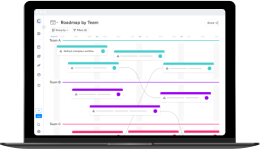
- Dynamic Roadmaps: Create custom roadmap views for different audiences. Show the Board a high-level “Outcome Roadmap,” while showing the Product Owners a detailed “Release Roadmap”—all powered by the same live ADO data.
3. Data Integrity Without the Manual Toil
Data is only useful if it is accurate. In the enterprise, manual data entry is a recipe for disaster.
- Bidirectional Sync: If a PM changes a priority or a description in Craft.io, it updates in ADO. If a developer updates a status or adds a comment in ADO, it reflects in Craft.io.
- Custom Field Mapping: Craft.io’s integration is highly flexible, allowing you to sync custom enterprise fields—like “Compliance Risk,” “Market Segment,” or “Cost of Delay”—ensuring your strategic data is always where it needs to be.
Scaling Your Product Excellence
Enterprise product management requires a balance of Autonomy (for the dev teams) and Alignment (for the organization). By integrating Craft.io with Azure DevOps, you provide dev teams the autonomy to work in ADO while ensuring the entire organization stays aligned with the strategic roadmap.
Drive Impact at Scale
Transformation starts with a single connection. The integration process is designed to fit into your existing enterprise security and permission models.
- Strategic Mapping: Align your Craft.io Initiatives with ADO Epics.
- Live Monitoring: Use webhooks for instant progress roll-ups.
- Governance: Maintain a clean, prioritized backlog that engineering can trust.
To see the full technical breakdown of how to map your ADO workspace to Craft.io, explore our Enterprise ADO Integration Guide.

FAQ: Craft.io + Azure DevOps (ADO) Integration
Can I sync multiple ADO Projects into a single Craft.io Workspace?
Yes. This is a critical feature for Enterprise Portfolio Management. Craft.io allows you to aggregate Work Items from multiple Azure DevOps Projects or Areas into one centralized strategic view. This is perfect for Product Directors who need to oversee cross-functional initiatives spanning different engineering teams.
Which Azure DevOps Work Item types are supported?
The integration is highly flexible. You can map Craft.io’s hierarchy (Initiatives, Epics, Features, Sub-features) to any ADO Work Item type, including Epics, Features, User Stories, or Tasks. It also supports custom Work Item types if your organization uses an “Inherited” process template.
How does Craft.io handle ADO Iterations and Sprints?
Craft.io can sync with your ADO Iteration paths. This allows Product Managers to see which Sprint a specific feature is assigned to directly within their roadmap. By syncing Story Points or Original Estimates, Craft.io also helps PMs track velocity and capacity at a high level without digging into ADO boards.
What is the benefit of using "Webhooks" with ADO?
Webhooks provide real-time automation. Instead of waiting for a manual sync, Craft.io “listens” for changes in ADO. The moment a Work Item is updated in Azure, the change is pushed to Craft.io. This ensures your executive roadmaps are always 100% accurate and reflect the most recent engineering reality.
Does the integration support custom field mapping?
Yes. Most enterprise teams have unique data needs. You can map standard fields (Status, Assignee, Priority) as well as custom fields (e.g., “Market Segment,” “Business Value,” or “Technical Debt”) between the two platforms to ensure no data is lost in transition.