Top 6 Craft.io Features from 2025 That Every Product Leader Should Know

Top 6 Craft.io Features from 2025 That Every Product Leader Should Know
In the rapidly evolving landscape of 2026, product management has shifted from managing “outputs” to obsessing over “outcomes.” For Product Owners, Product Managers, and Marketing Leaders, the challenge remains the same: how do you take a high-level vision and ensure it doesn’t get lost in the noise of daily execution?
In 2025, Craft.io released a series of monumental updates designed to solve exactly that. By turning the platform into a connected ecosystem, these features allow teams to treat their product strategy as a living, breathing entity.
Below, we explore the top six releases from 2025 in a logical workflow covering the end-to-end product lifecycle, showing how they help leaders bridge the gap between their biggest ideas and actual delivery.
1.Capturing High-Impact Feedback through the Enhanced Feedback Portal
The Feedback Portal is a centralized hub where customer requests are collected, categorized, and linked directly to your product backlog to ensure data-driven prioritization.
Every great product begins with the voice of the customer. In 2025, Craft.io transformed the Feedback portal by introducing company-level enhancements. Previously, feedback was often a disorganized list of requests. Now, product leaders can group and filter entries by specific organizations.
Why this matters for your strategy:
- Identify Revenue Drivers: See exactly what your most valuable accounts are requesting.
- Data-Driven Backlogs: Move away from “gut feel” and prioritize based on real market demand.
- Customer Transparency: Close the loop by updating specific companies on the status of their requests.
By connecting user needs to the backlog early, you ensure that the very start of your product lifecycle is fueled by high-value data.
2. Streamlining Discovery with Guru Templates and AI Content Generation
Guru Templates are pre-configured, AI-powered frameworks that help teams standardize Product Requirement Documents (PRDs), user stories, and feature definitions.
Once you’ve identified a customer need, the next step is defining the solution. In 2025, Craft.io addressed the “blank page” problem by introducing advanced Guru templates powered by Guru AI.
Instead of spending hours drafting documentation, Guru AI (powered by Craft AI) acts as a digital thought partner. By leveraging AI to summarize complex features or generate initial descriptions, PMs can move from ideation to a structured plan in a fraction of the time. This ensures that every item in your workspace follows a consistent, high-quality format.
To see how these structures can be applied across different workflows, explore the variety of Guru views available in the platform.
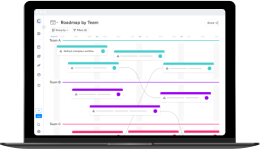
3. Visualizing Your Vision on a Dynamic Swimlane Timeline
A Swimlane Timeline is a roadmap visualization that organizes product items into horizontal “lanes” based on categories like team, priority, or release phase.
The release of the New Timeline View in 2025 introduced a more flexible way to visualize your product’s journey, simplifying stakeholder management through enhanced swimlane timeline logic. For a Marketing Leader, seeing a timeline grouped by “Market Segments” ensures that launch activities are perfectly synchronized with feature readiness.
Key Visibility Benefits:
- Multi-Dimensional Views: Pivot between Team, Epic, or Release views instantly.
- Stakeholder Alignment: Provide executives with a high-level summary while giving dev teams the detail they need.
- Dependency Management: Spot potential overlaps between different product lanes before they become delays.
Learn why timeline and swimlane roadmapping outperform the market when it comes to stakeholder transparency.
4. Balancing Ambition with Reality through Capacity Planning
Capacity planning is the process of calculating team workload and velocity to ensure your roadmap is realistic and achievable within your current resource limits.
A roadmap is only a wish list until you validate it against your resources. To solve this, Craft.io introduced Workspace Capacity Planning in 2025. By defining team velocity and individual availability directly within the workspace, capacity planning becomes an automated part of your workflow.
When you move a feature onto your timeline, the system automatically checks it against your team’s actual bandwidth. If a team is over-allocated, the platform provides a visual warning, allowing you to make data-driven decisions about what to prioritize and what to delay.
Pro Tip: If you’re new to resource management, check out our capacity planning step-by-step guide to get your workspace set up for success.
5. Mastering Execution with Redesigned Roadmapping Tools
In Craft.io, Product Roadmapping is the live synchronization of strategic goals with tactical tasks, providing a real-time view of progress.
The 2025 Redesigned Timeline Roadmap View was built for the daily grind of execution. The update introduced a streamlined interface with a powerful side panel that allows for instant editing. This evolution in roadmapping means you no longer have to jump between menus to update a feature’s status or priority.
For Marketing Leaders, this level of efficiency is crucial for cross-functional alignment; when development priorities shift, the marketing plan can shift with them. It ensures the entire organization relies on a ‘single source of truth’ for product health, launch timelines, and delivery milestones.
Not sure which layout is best for your team? Explore these 5 awesome roadmap examples you’ll want to use.
6. Gaining Instant Decision-Support with Guru AI and “Ask” Feature
Ask Guru AI is a conversational AI interface that allows you to query your product data using natural language to get instant summaries and insights.
The final piece of the connected product system is the ability to extract insights instantly. The “Ask Guru AI” feature allows you to interact with your workspace like a strategic advisor.
Instead of manually searching through boards to find out which team is over-capacity or which customer requests are trending, you can simply ask the AI. The Guru AI (powered by Craft AI) analyzes your entire workspace—from your Feedback trends to your capacity planning—to provide a summarized answer.
Popular queries for product leaders include:
- “Summarize the current progress of our Q3 roadmap goals.”
- “Which features are currently blocked by dependency issues?”
- “What are the top three feedback themes from our Enterprise clients this month?”
Conclusion: A Connected System for a Modern Era
The updates of 2025 have solidified Craft.io as the premier platform for leaders who value both strategy and execution. By following this workflow—from initial Feedback to AI-assisted insights—you ensure your team maintains cross-functional alignment throughout the product lifecycle, focusing only on the work that matters most.
As we move through 2026, the teams that succeed will be those that treat their product data as a connected ecosystem. With Craft.io, you have the tools to bridge the gap and drive real business results.
Stop guessing and start delivering. Don’t let your big ideas get lost in the noise. See how Craft.io’s connected workspace can align your team and drive business growth.
Sources & research:
- Craft.io Help Center: New Timeline View
- Craft.io Help Center: Using the Redesigned Timeline Roadmap View
- Craft.io Help Center: Feedback Portal Company Enhancements
- Craft.io Help Center: Getting Started with Craft.io’s Guru AI
- Craft.io Help Center: Workspace Capacity Planning Overview
- Craft.io Help Center: Ask Guru AI

FAQ
How do these updates help connect my strategy to my team’s daily work?
Craft.io creates a “single source of truth” by linking your strategic “Why” directly to tactical tasks. By using the Feedback portal to identify needs and Guru templates to define them, every feature on your swimlane timeline remains physically connected to your high-level goals.
Can I use Guru AI to manage a large volume of customer feedback?
Yes. Instead of manually reading hundreds of requests, you can use Ask Guru AI to summarize key themes instantly. The AI analyzes company-level data to identify trending needs, helping you move from raw data to a roadmap decision in seconds.
How does Workspace Capacity Planning prevent over-promising?
Craft.io’s capacity planning tool compares your roadmap against your team’s actual velocity and availability. If you attempt to schedule more work than your team can handle, the system provides a visual warning, allowing for data-backed conversations with stakeholders about what is realistically achievable.
Why is the Swimlane Timeline better for stakeholder management?
Unlike static roadmaps, the swimlane timeline allows you to pivot your view instantly. You can show Marketing Leaders a view grouped by “Launch Phases” while showing Engineering a view grouped by “Development Teams,” ensuring every stakeholder sees the data that matters most to them.
How can Marketing Leaders stay synchronized with development?
Through the redesigned timeline roadmap, marketing teams can create their own swimlanes for campaign activities directly alongside product features. Since the data is live, any shift in development is immediately visible, allowing Marketing to adjust go-to-market strategies proactively.