The Role of the Technical Product Manager: Responsibilities & Skills
One great way to understand what a Product Manager does is to think of the role as similar to a sports coach. Managing products requires coordinating, guiding, and inspiring many people across a business. And just as coaches probably can’t run as quickly or jump as high as their players, most Product Managers don’t have as much expertise in any area of the work they’re guiding – marketing, sales, development, QA – as the professionals in those roles.
So, when it comes to better understanding the technical aspects of the products they’re bringing to market, some companies add a specialist – a Technical Product Manager – to their products teams.
In this post, we’ll review the typical responsibilities of a Technical Product Manager, discuss how some of the role’s key characteristics differ from those of the skills required for traditional Product Managers, and offer a few suggestions to help you make yourself a viable candidate for a Technical Product Manager position.
What Is a Technical Product Manager?
In most companies, a Technical Product Manager will have responsibilities that are similar to those of a traditional Product Manager. Both are strategic roles and are ultimately responsible for the market success (or failure) of the products they oversee.
Broadly speaking, for example, both Product Managers and Technical Product Managers are responsible for:
- Market Research: Finding opportunities and needs that the company can profitably address.
- Persona Development: Becoming familiar with intended users to learn how best to solve their problems.
- Strategy: Helping to develop business objectives for the product.
- Communication: Sharing the strategic vision with stakeholders across the company.
- Product Roadmapping: Building and maintaining the plan for the product’s future.
However, beyond these high-level similarities, the technical product manager dives much deeper into how the product is built.

Key Technical Product Manager Responsibilities
So, what does a technical product manager do that is different? While a traditional PM focuses on the “Why” and “What,” the TPM is heavily involved in the “How.”
A Technical Product Manager will tend to have more responsibility for the architectural and engineering aspects of their company’s products. For example, a TPM might:
- Become deeply involved with the product backlog.
- Work directly with the development team on tactical details.
- Assess the feasibility of proposed features based on the current tech stack.
- Translate complex technical constraints into plain language for business stakeholders.
Required Background and Technical Skills for a TPM
A Technical Product Manager will typically have a stronger technical background than a traditional PM. This often includes specific technical skills for product manager success, such as:
- Degrees or certifications in computer science, engineering, or IT.
- Hands-on experience with APIs, cloud infrastructure, or data engineering.
- Experience working as a traditional PM specifically for complex technology companies.
However, businesses looking for Technical Product Managers often understand that a CS degree isn’t mandatory. You can still be highly qualified to carry out the strategic aspects of the position if you have experience working closely with engineering teams to build complex technology products
What Will You Be Doing as a Technical Product Manager?
If you are wondering what does a technical product manager do day-to-day, the answer often depends on the company size. If you are reviewing job descriptions for this role, you will typically find they fall into one of two categories.
Scenario 1: Managing technical products.
As we noted above, many businesses hiring Technical Product Managers are looking primarily to fulfill the responsibilities of a traditional Product Manager – but also want the person in this role to understand the company’s technical products and development processes at a deeper level than they’d find with a PM who comes from, say, a business or marketing background.
In these cases, you’ll find the job’s responsibilities reading very similarly to the role of a conventional Product Manager: Identifying market voids and opportunities, communicating with users and other stakeholders, devising and testing new ideas for products, etc.
Scenario 2: Acting as a Technical Advocate.
You’ll find this type of Technical Product Manager role only in much larger enterprises. In contrast to the scenario above, where the Technical Product Manager is the company’s Product Manager, here the role will be supplemental to the primary Product Manager. Only larger organizations will have the budget to hire for this position.
The role itself will be different as well. As this type of Technical Product Manager, you will be primarily serving as a liaison between the product and development. Your role will be to monitor the development teams’ technical decisions for the product – coding languages, integrations, where to allow technical debt, etc. – and making sure that these decisions align with your company’s strategic objectives.
 You won’t have authority on these technical decisions regarding building and enhancing the product – that will fall to the development managers and executives. But you’ll play an important role in making sure the development team’s discussions and prioritization exercises when it comes to technical decisions always factor in the broader product and company priorities.
The #1 Technical Skill for Product Manager Success
As we noted above, many of the skills you’ll need to succeed as a Technical Product Manager overlap with those you’ll need to be effective in any product management role.
But because you’ll be communicating more directly in this role with your company’s technology teams, success as a Technical Product Manager will also require you to speak the language of Development or Engineering.
This doesn’t mean you need a degree in engineering, computer science, or some other technical field. (Although that wouldn’t hurt. But to master the core technical skills for product manager roles, you need:
- Deep Tool Knowledge: A solid understanding of the stack your developers use.
- Effort Estimation: Knowing roughly how much effort a task takes so you can write effective user stories
- Technical Prioritization: Knowing how to balance technical debt against new features.
Additionally, the more you can demonstrate to your development team colleagues that you understand their work at a technical level – in other words, the more fluently you can speak their language – the more likely you are to earn their respect. And when the development team respects your knowledge and understanding, that will strengthen the effectiveness of your working relationship.
Bonus Tip: Get Familiar with Product Management Software
If you’re interested in building a career as a Technical Product Manager, an effective way to learn the types of work you’ll be doing is to play around with one of the widely used software platforms that product teams use both to get their own strategic work done and to collaborate with their development department.
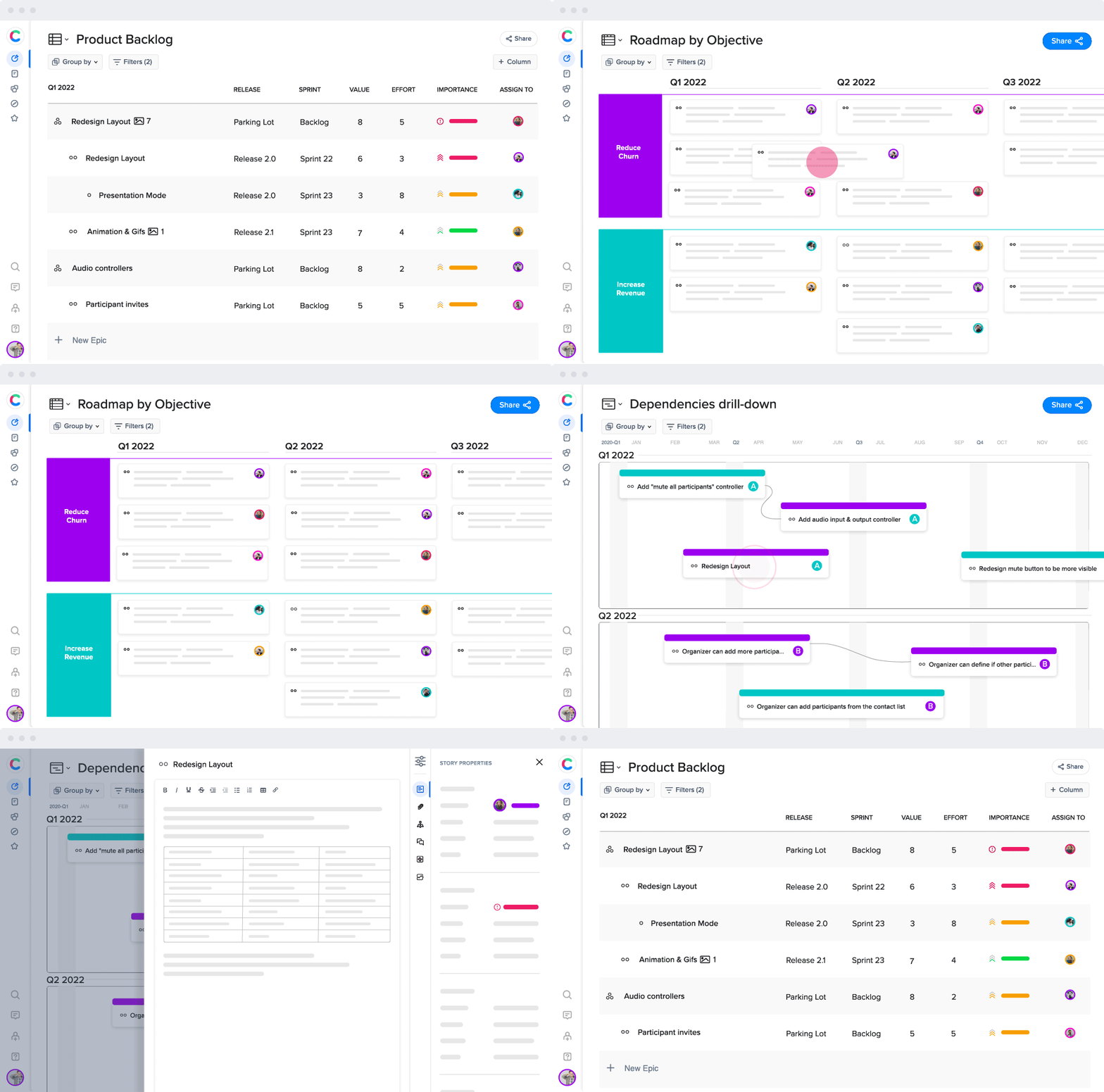
Our recommendation: Familiarize yourself with the end-to-end product management platform from craft.io. You’ll get a sense of the major strategic areas you’ll be working on as a Product Manager (including roadmapping, prioritization, backlog, capacity planning, etc.). And because craft.io helps connect product and development teams’ work, spending some time in the platform will also give you an understanding of how you’ll be working as a Technical Product Manager with your development colleagues.
The great news is that you can start using craft.io for free, right now.
FAQ
What skills do technical product managers need?
TPMs require deep technical knowledge (like software engineering) alongside strong communication, program management, organizational skills, and strategic planning.
Do I need coding skills to be a Technical Product Manager?
Not necessarily. You don’t usually need to write code, but you must understand the tech stack and speak “developer language” to accurately estimate technical effort and debt.
What are the key technical product manager responsibilities?
Key responsibilities include defining technical requirements with engineering, managing the backlog, and assessing feature feasibility. They bridge the gap between business strategy and code delivery.
How does a Technical Product Manager differ from an Engineering Manager?
A Technical Product Manager focuses on the product’s technical strategy and “what” to build. An Engineering Manager focuses on the people, managing the developers’ careers and the “who” behind the code.