What Is Product Planning?
The most comprehensive definition we’ve found for product planning comes from Kenneth Kahn’s book, Product Planning Essentials:
“Product planning is defined as the process of envisioning, conceptualizing, developing, producing, testing, commercializing, sustaining, and disposing of organizational offerings to satisfy consumer needs and wants and achieve organizational objectives.”
Put more simply, product planning is the collection of processes and tools a business uses to plan the creation of a new product and the ongoing market success of that product throughout its lifecycle.
(And if you’d like more great quotes and insights on product management, check out our free eBook: Product Wisdom.)

Key Inputs in the Product Planning Process
Let’s put this into more concrete terms. When a product team sets out to plan a new product, they will face many strategic decisions. The process often begins with ideation, where the team brainstorms potential solutions to market problems. From there, here are some of the most important criteria the team will need to take into account and the questions they’ll need to ask:
- Answering “why”: the product’s reason for being
A product team should never start building a product until they’ve first answered the all-important question, “Why?” Why do we think this solution will succeed? Why does the market need it and why will people pay to buy it?
- The product’s target customer(s)
Who will be buying and using this product? How will we make sure we’re building the right functionality to make the product appealing to these potential customers?
- The competitive landscape
Are there similar solutions on the market, or will our product create a new category? If there are no comparable products, how will we articulate its value in a way that resonates with our target persona? Do no such products exist because our user persona doesn’t actually need them? And if competitive products already exist, how will we differentiate ours from the others?
- The product strategy
Will we build and release a Minimum Viable Product (MVP) to start gathering market feedback as quickly as possible, or will we wait until we’ve built a more complete product before releasing it to the market? If we choose the MVP approach, which functionality will we prioritize for that early version?
- The pricing strategy
Will we segment the product into different offerings — with varying levels of functionality and support — and offer it at different price points? If our product is software, will we offer it for a one-time purchase, on a monthly or yearly subscription? And if we offer the subscription model, will we offer a price break for yearly subscribers?
- The measures of success
After we’ve released our product to the market, how will we gauge success? Will we focus on trial signups, revenue within a specific timeframe, market share, MRR and ARR, or other metrics?
Why Is Product Planning Important for Success?
As you can see from the list above, developing a new product requires answering many important questions. And the examples we listed here represent only a few of the inputs a product team will need to think through as they begin this process.
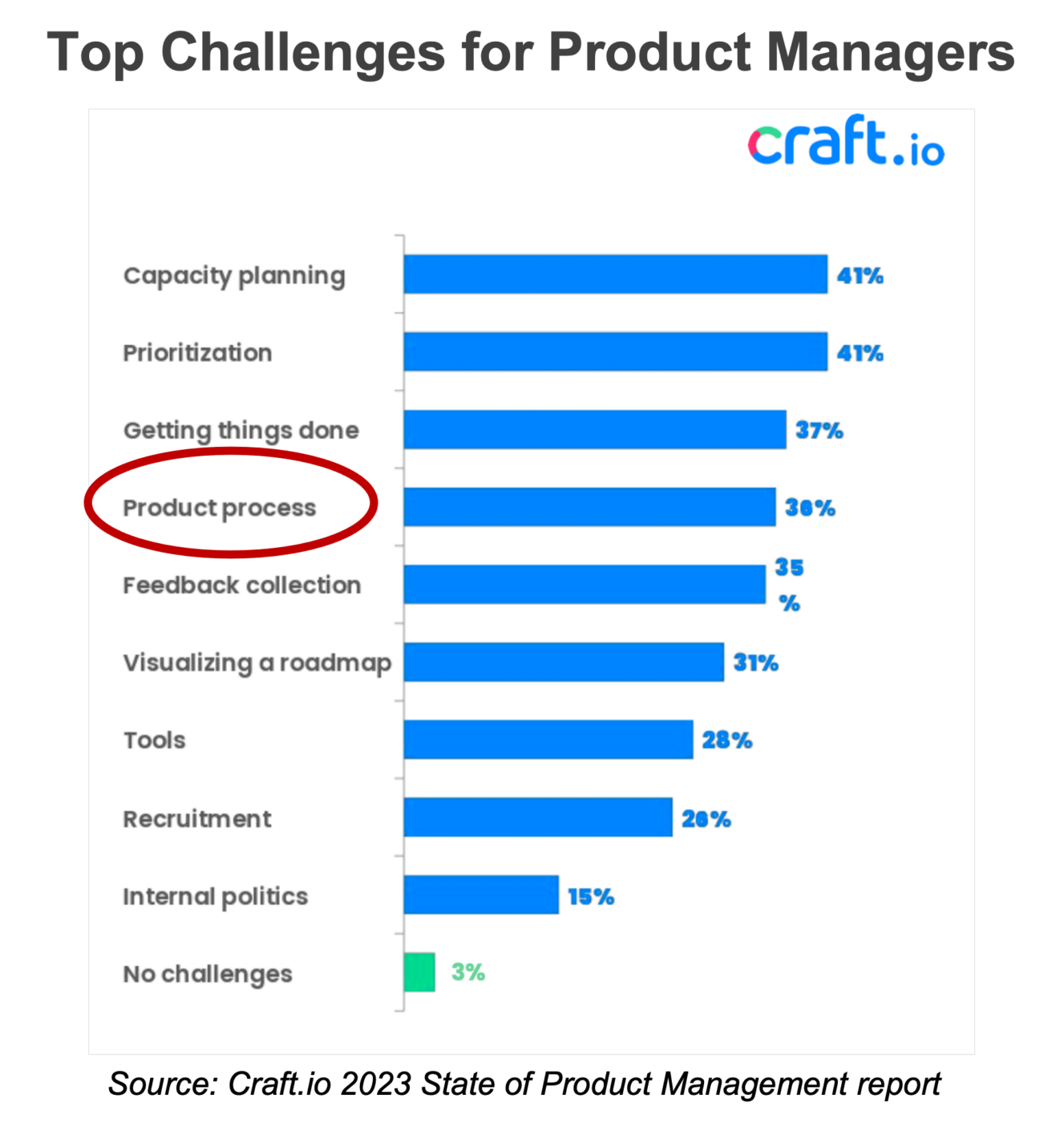
In fact, simply building this list of product planning steps can be difficult. When we surveyed hundreds of professionals for the craft.io 2023 State of Product Management Report, we learned that one of their top challenges was developing a clearly defined product process.

No product team, regardless of how experienced and committed they are, can guarantee a product’s success. But conducting an intelligent, thoughtful planning process at the earliest stages — and frequently revisiting and revising their strategy throughout the product’s development — can help a team avoid many of the common pitfalls that can lead to building and launching a product that fails to resonate with users. And this is why learning how to develop and execute on an effective product process is one of the key skills for a Product Manager.
Real-World Product Planning Examples
How does this look in practice? Here are three common scenarios where teams use production planning and control tools to make high-stakes decisions.
1. Defining MVP Functionality
Scenario: A home appliance manufacturer is building a companion app for a new dishwasher. The Planning Move: Instead of guessing which features matter, the team surveys target users on a specific trade-off: Remote wash cycles vs. Maintenance alerts.
Pro Tip: While user feedback is a vital part of your product plan, don’t over-rely on feedback for your product decisions. Use data to inform your vision, not replace it.
2. Testing Pricing Strategies
Scenario: A mobile game developer isn’t sure if they should go “Free-to-Play” (ad-supported) or “Premium” (paid). The Planning Move: They launch a split-test version of the app, offering both a free ad-supported tier and a paid ad-free tier. By tracking real-world conversion rates, they let user behavior dictate the long-term monetization strategy.
3. Portfolio Resource Allocation
Scenario: A software firm has a mix of “Legacy” products and “New Growth” products. The Planning Move: The team performs a master production planning audit. They analyze whether legacy products are declining due to market fatigue or a lack of internal support. This data helps them decide whether to “milk” the legacy revenue to fund new innovation or reinvest to revive the mature products.

Best Practices for Your Product Planning Process
Effective product planning will require different inputs and emphasize different priorities according to your products, customer persona, industry, company size, industry, and other factors. But here are a few best practices that will likely apply to every team’s planning process.
1. Identify your success metrics.
Like so many other aspects of successful product management, product planning is about making smart strategic trade-offs. You’ll never have unlimited time and resources as a Product Manager, and that means you’ll need to continually make decisions about which items to focus on and which to shelve for later.
- Focus on narrow success criteria: While new features are exciting, you must focus on maintenance and technical debt if you want to keep existing customers satisfied for the long term. Remember the Southwest Airlines scheduling and flight-delay fiasco? Turns out that was directly related to ignoring technical debt for too long.
- Balance growth with retention: Ensure your plan allocates enough resources to keep existing customers satisfied while chasing new market wins.
2. Make your plan simple and easy to explain.
The product planning process is complicated and messy — requiring brainstorming, research, confusing and even conflicting data points, challenges from coworkers, etc. That’s to be expected. But the strategic plan you develop should be simple to articulate and grasp.
- Use tailored roadmap views: Ensure you use the right roadmap view for each audience. You can use a platform built specifically for Product Managers, like craft.io, to quickly change views and display the specific data a situation calls for.
- Pass the elevator test: A complicated product plan that you could not explain during a short elevator ride represents a red flag. If you cannot clearly articulate your plan, you will have difficulty aligning stakeholders and steering them in the right direction. For a personal walkthrough of such a solution, book your free demo of craft.io.

3. Ask stakeholders to review and look for holes in the plan.
Another valuable step in this process is to practice defending your plan with your stakeholders. Invite them to review it, ask tough questions, and even challenge your ideas and conclusions.
- Strengthen your strategy through feedback: Defending your product plan against critics helps you sharpen the plan itself. It allows your cross-functional team to uncover potential flaws in your logic or your ability to articulate your reasoning.
4. Monitor your progress throughout the plan, and adjust accordingly
Product planning is not a one-time exercise you conduct only at the beginning of your development. It should be built into all of your product management efforts.
- Treat planning as an ongoing process: Revisit the plan frequently to make sure it still represents your current strategic priorities and capacity levels.
- Inform your daily decisions: Think of product planning as a strategic process always running in the background of your team’s work rather than a static activity.

Product Planning Tools
One final best practice we didn’t list above: Find the right product management solution to help make your team’s product planning more efficient and effective. That solution should centralize product content to make performing your product planning research and decisions easier. For example, it should offer a platform that lets you centralize your:
- Product strategy
- Roadmap
- User feedback analysis
- Capacity planning
- Product backlog
- Prioritization exercises
For help identifying the right solution for your company, check out our free eBook: The Enterprise Product Management Platform Buyer’s Guide.