How to Write a Epic User Story

As a [button presser],
I want to [have a button]
so that [I can press it].
Technically speaking, that statement above is a user story written in the proper format. But as you probably noticed, it’s not a very effective one. It doesn’t tell you anything substantive about the user, what they want from the product, or why it matters to them — three things every good story needs.
The good news is that writing an epic user story isn’t some complex, mysterious formula that only experienced product professionals can do well. There are many more difficult areas of product management, such as making smart prioritization decisions or building roadmaps that don’t suck, that will take time for you to master. With the guidance in this post, you’ll be writing excellent epics and user stories in no time.

But that doesn’t mean the process is easy. Drafting a sample epic story that is clear and compelling takes hard work. It also requires avoiding common pitfalls that can lead to confusion, wasted resources, and poorly made products.
So let’s get to work. First, we’ll explain what an epic user story is and where it lives in the larger context of your product strategy. Then we’ll show you how to write a great one.
And if you’re looking for an easy jumpstart to writing great user stories — including fill-in-the-blank templates for various story formats — you’ll find it all in the craft.io product management platform

Try craft.io for free
What Is an Epic User Story?
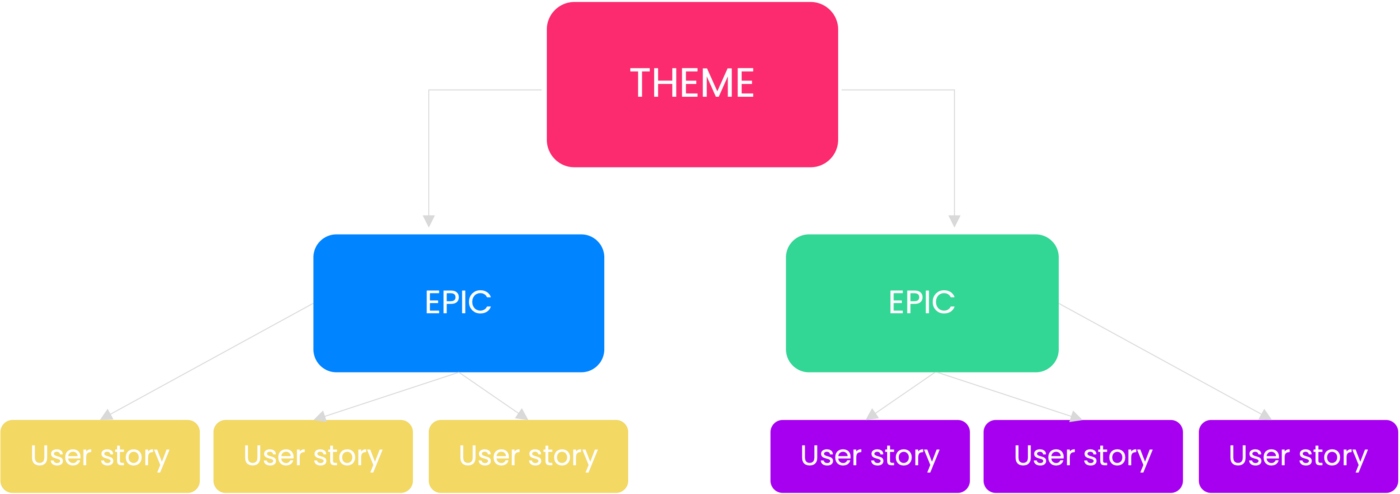
We’re not high-school students here at craft.io, so when we say “epic user stories,” we don’t mean stories that are really cool. We’re talking about user stories grouped together under a related body of product development work called an epic. Here’s what that hierarchy looks like.
The agile development hierarchy: theme > epics > user stories.
To master the agile user story epic structure, you must understand how these elements roll up into your larger strategy. To understand this better, we look at the agile development hierarchy:
- Theme: This is your high-level strategic idea or primary initiative.
- Epics: These are the large bodies of work required to bring a theme to life.
- User Stories: These are the smallest units of work, representing a single goal or desired outcome.
- Epic User Stories: This term specifically describes stories that roll up into a common epic.
Note: If you’re new to the profession, remember that epics and user stories are distinct from use cases, which focus on functional requirements rather than user value.
(Oh, and in case you’re very new to the product profession, you should also know that user stories and use cases are very different things.)
The standard format for an epic user story.
While some teams utilize the problem-solution approach or A/B test formats, the most effective sample epic story follows a concise, three-part statement:
As a [type of user], I want to [goal], so that [reason].
Looks simple, right? And it is. But don’t let the concise construction deceive you. To ensure these stories guide development effectively, keep the following in mind:
- Precision is key: You must define your user persona and their “why” carefully to avoid confusing stakeholders.
- Plain language: Use simple construction to ensure the objective remains clear for developers.
- Focus on value: Ensure the “so that” portion of the statement identifies a real benefit, not just a technical task.
How to Write a Great User Story (and How to Fail)
Imagine your SaaS team is coming up with ideas for a new product: an app that lets traveling professionals record and submit expenses while on the road. One piece of functionality you want to include is the ability to photograph a paper receipt (say, a restaurant bill) with the user’s phone and upload it to their expense report.
Even with a standard format, there are several ways to fail when drafting epics and user stories. Here are three common epic user stories examples of what to avoid:
User story mistake 1: the poorly defined user.
Bad Example: “As a [businessperson], I want to [connect this app to my phone’s camera] so that [I can scan photos of my receipts].”
- The Issue: The user persona is too broad.
- The Impact: Developers need to know the user is a “frequent traveler” who generates many receipts on the road. Without this detail, stakeholders miss the core value proposition: mobile-first expense reporting from anywhere.
User story mistake 2: the misunderstood goal.
Bad Example: “As a [traveling professional], I want to [connect this app to my phone’s camera] so that [I can scan photos of my receipts].”
- The Issue: This describes a technical requirement, not a user goal.
- The Impact: A traveling professional doesn’t “want” to connect to a camera—that is just a background detail. Their actual goal is to easily photograph and submit receipts for reimbursement.
User story mistake 3: the unidentified value proposition.
Bad Example: “As a [traveling professional], I want to [photograph paper receipts] so that [I can scan photos of my receipts].”
Now the writer has done a good job with the first two sections of the statement — identifying the important traits of the user and describing a solid goal that this user would want to achieve. But in the final part of the story — the why — the writer is missing the opportunity to articulate the overall value proposition the functionality brings to the user.
- The Issue: The “why” is missing the actual value.
- The Impact: Scanning isn’t the end goal; saving time is. If developers don’t understand that the value is “completing the workflow on the go,” they might mistakenly design a system that still requires a desktop computer for final submission.
So let’s pull this all together…
The right way to write this user story.
To create a truly effective epic feature user story, pull all three elements together into a clear, value-driven statement:
As a [professional who travels frequently for work], I want to [be able to photograph paper receipts with my phone and pull them into the app] so that [I can easily complete and submit expenses from the road without wasting a lot of time].

Things to Remember When You’re Writing Epic User Stories
1. You’re not the developer.
Often a Product Manager or Product Owner writing a user story has the mistaken idea that the story will be clearer or easier to complete if they include a bit of technical advice.
The online community AgileConnection offers a great example of a user story whose writer snuck in some technical direction when it was neither necessary nor even the best suggestion:
As a Manny’s food service customer, I want to see different food item types displayed in different colors—RGB = #FF0000 for meats, #A52AFA for grains, and #808000 for vegetables and fruits—so that I can quickly identify my food items by food type.
Another example, in a software company, might be a writer stating the user wants to “choose from a drop-down menu,” when the software developers might have ideas for displaying the options more conveniently for the user.
Remember that your goal in writing epic user stories is to explain succinctly what your user wants to do and why it matters to them. Leave the how to your developers. They know that stuff better than you do.
2. You’re not a novelist.
The average fiction book for adults is 90,000 words. For books written for elementary-school children, the typical word count is in the 5,000-10,000 range. When you’re writing an epic user story for your development team, you’ll have about 50 words. And 25 would be better.
One of the ingenious things about the standard user story format — As a [type of user], I want to [goal] so that [reason] — is that it forces product teams to understand what they want and why for their user so clearly that they can explain it in just one plain-language sentence.
If you find yourself writing lengthy statements to describe your user or the problem they’d like to solve, that could be an indication that you need to give your proposed story more thought before you write it.
3. You’d better have your theme and epic written.
To be effective in your product planning, you need to take the top-down approach. First, you come up with a big-picture strategic theme. Then you translate that theme into epics. And finally, you break those epics down into the smallest self-contained units of work — the user stories.
Why is this so important? Because the theme and epic are where your team will draw your understanding of both the user persona you’re trying to serve and that person’s goals and the value they’re hoping to achieve.
In the example above, if the writer hadn’t been clear that the user would need to complete the entire expense submission process on a mobile device — because they’re always on the go — that could have led to misinformed development choices.
That’s why you’ll need to start with your theme (“Enable entire expense workflows on the road”), then the epic (“Make mobile submissions easy”), and finally your user story (“Scan and upload receipts from your phone”).
We hope this guidance helps you make your epic user stories… epic.
— Team craft.io
Try craft.io for free

FAQ
What is the difference between an epic vs user story?
The difference is hierarchical: an epic is a large body of work, while a user story is a smaller, self-contained unit within that epic. Epics support strategic themes, while user stories define the specific actions to complete them.
What are some epic user stories examples?
A high-quality epic user story example follows a specific format: “As a [traveling professional], I want to [photograph receipts] so that [I can submit expenses on the go without wasting time]”. This identifies the user, the goal, and the value.
What is an epic feature user story mistake?
A common mistake is focusing on technical requirements (e.g., “connecting to a camera”) instead of the user’s actual objective or value proposition (e.g., “saving time on the road”).