What Is Product Feedback Management and How Do Product Teams Use It?
Product feedback management is the process of collecting, organizing, and acting on input from customers, internal teams, and stakeholders about your product. That input might be a feature request from a key account, a bug report from a power user, or a pattern of complaints surfacing in support tickets.
The goal is not just to gather that input – it is to turn it into decisions. Which requests get built? Which get deprioritized? Which reveal a deeper problem the team has not yet named? Without a structured process, those questions get answered by whoever shouted loudest in the last meeting, not by what the data actually shows.
Product feedback management sits at the center of the product management workflow. It connects the voice of the customer to the product backlog, to prioritization decisions, and ultimately to what ships on the roadmap.
Why Ad-Hoc Spreadsheets Break Down
Most teams start with a shared spreadsheet. Someone creates a tab for feature requests, another for customer calls, maybe a third for support escalations. It works until it does not.
Spreadsheets have no mechanism for de-duplicating requests. The same feature might appear thirty times under different names, submitted by different teammates who all heard it from different customers. There is no way to see at a glance how many customers want a given capability, which customer segments those requests came from, or how a request maps to the company’s current strategic priorities.
There is also the maintenance problem. Spreadsheets require someone to keep them current manually. When that person is busy – and they always are – the sheet goes stale. New requests pile up without being triaged. Old ones sit there unresolved, with no record of why the team chose not to act on them.
The result is that product decisions get made on incomplete information. Teams build features that feel urgent rather than features that are actually important. And when a Head of Product or CPO asks why a particular customer request was deprioritized, there is no clean answer because the reasoning was never captured anywhere.
How a Structured Process Changes the Decision
A structured approach to product feedback management replaces the spreadsheet with a system that does three things a spreadsheet cannot: it aggregates requests, it connects them to customer context, and it links them directly to prioritization and roadmap tools.
When a customer submits a feature request through a dedicated feedback channel, the system captures who asked, from which account, and how that account is categorized – whether by tier, revenue, industry, or some other segment the team cares about. When ten customers ask for the same thing, those requests consolidate under one item rather than fragmenting across rows.
That consolidation makes prioritization tractable. Instead of reading through hundreds of individual rows, product managers can see that a specific capability has been requested by a large number of enterprise accounts and has been sitting unresolved for several quarters. That is a very different kind of signal than a single loud request from a vocal customer.
From there, the feedback connects directly to the backlog. Items that clear the prioritization threshold move forward. Items that do not stay visible, so the team can revisit them as strategy evolves. Nothing disappears into a forgotten tab.
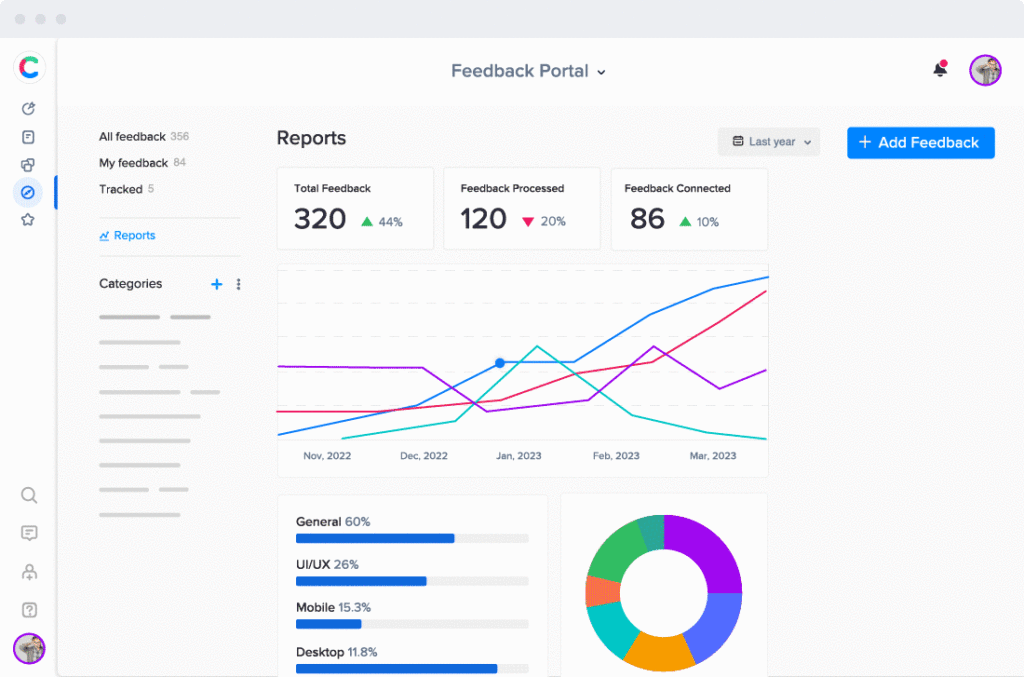
craft.io’s feedback module is built for exactly this workflow. It lets teams collect and centralize feedback, apply scoring and prioritization frameworks, and connect approved items to features on the roadmap – all within the same platform where the roadmap itself lives. For more on managing incoming requests, the craft.io knowledge base covers practical tips for managing feature requests and how to manage customer feedback in a product context.
Connecting Feedback to the Roadmap
The point where feedback management earns its place is when customer input actually moves something on the roadmap. That connection is harder to make than it sounds.
In most teams, feedback and roadmap planning happen in separate tools and separate conversations. A PM reads through customer feedback, extracts themes, writes them up, and then presents a summary in a planning meeting. The original feedback – who asked, how many times, in what words – is already one layer removed from the decision.
When feedback management and roadmapping are in the same system, that gap closes. A feature request can be promoted directly into the backlog. The roadmap item carries a record of how many customers requested it and which accounts they belong to. When a stakeholder asks why a feature is on the roadmap, the answer is built into the item itself.
This matters especially for teams reporting to a Head of Product or CPO who needs to justify the roadmap to leadership or to customers. A feedback trail is not just useful for product decisions – it is useful for the business case that surrounds those decisions.
Teams looking to go deeper on the prioritization side can read more about craft.io’s product prioritization tools and the feedback management module on the platform pages.
What to Look for in a Product Feedback Management Tool
If your team is evaluating dedicated product feedback management software, a few capabilities separate tools worth considering from tools that replicate spreadsheet problems in a prettier interface.
- Centralized collection: Feedback from multiple sources – customer success, sales, support, direct submissions – should land in one place, not scatter across channels.
- Request consolidation: The tool should make it easy to merge duplicate requests and count how many customers or accounts are behind a given item.
- Scoring and prioritization: Built-in frameworks for feature prioritization let teams make consistent decisions rather than relying on gut feel or recency bias.
- Roadmap integration: Feedback items should connect directly to the roadmap, not require a manual export and re-entry step.
- Spec and backlog connection: Once a request becomes a feature, the tool should support the work of writing it up and connecting it to delivery, including integrations with tools like Jira.
craft.io covers all of these within a single platform. Product managers can collect feedback, apply prioritization scoring, move approved features onto the roadmap, write specs, and push work to Jira – without switching between disconnected tools. If you want to see how it fits your team’s workflow, you can book a demo or explore pricing to get started.