The Product Manager’s Guide to Feature Prioritization Frameworks
Every product backlog has more ideas than time. Sales wants the enterprise feature that closes deals. Engineering wants the refactor that prevents outages. Customers keep requesting something you promised two quarters ago. Without a shared framework, these conversations become political, and the loudest voice in the room wins.
A prioritization framework gives your team a repeatable way to evaluate features against each other using agreed-on criteria. It creates a paper trail for decisions, makes trade-offs visible to stakeholders, and gives you a defensible answer when someone asks why their request did not make the cut.
This guide covers four frameworks product managers use most often: RICE, MoSCoW, weighted scoring, and value vs. effort. For each one, you will find what it measures, when it works best, and how to run a session with your team.
The Four Frameworks and When to Use Them
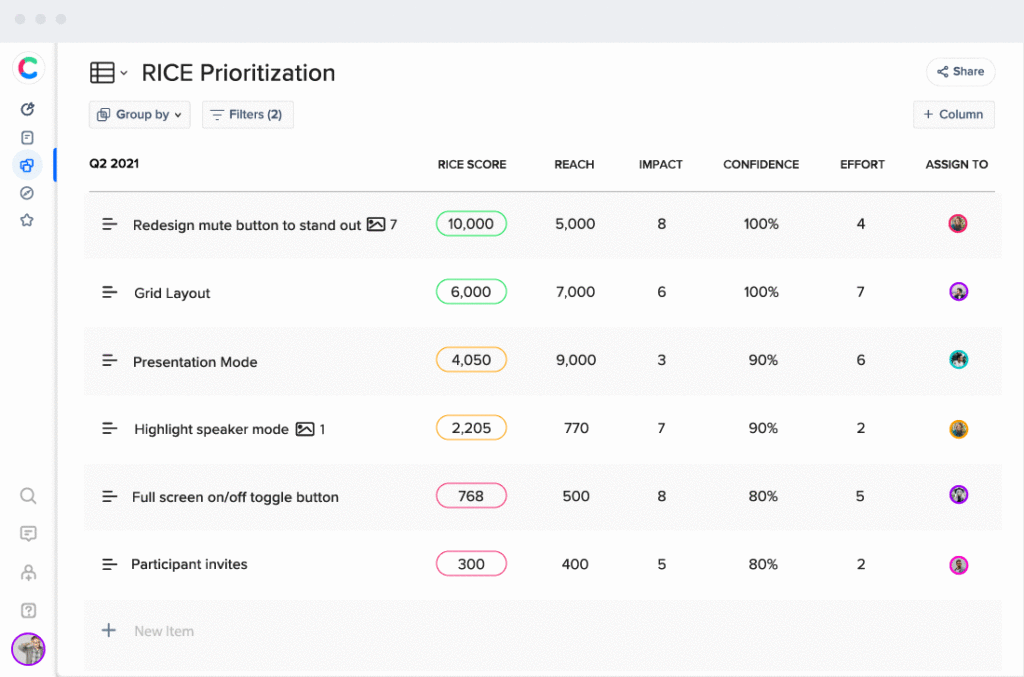
RICE scores each item on four dimensions: Reach, Impact, Confidence, and Effort. You multiply the first three together and divide by effort to produce a single number. Higher numbers go higher on the roadmap. RICE works well when you have enough usage data to estimate reach and impact with some confidence. It falls apart when your product is early-stage and those estimates are mostly guesswork.
MoSCoW sorts items into four buckets: Must Have, Should Have, Could Have, and Won’t Have. It is the fastest framework to run with a group of stakeholders because the categories are intuitive. Use it when you need a quick consensus on a release scope, or when a detailed scoring model would introduce false precision. The risk is that everyone wants their request in the Must Have bucket, so the PM needs to hold the line on what the release can realistically deliver.
Weighted scoring lets you define custom criteria and assign a weight to each one. A team shipping a compliance-heavy product might weight regulatory risk heavily. A team focused on growth might weight customer acquisition impact above everything else. Each feature gets a score on every criterion, the scores are multiplied by the weights, and the totals are compared. This approach takes more setup than the others, but it produces decisions that are clearly tied to your product strategy rather than gut feel.
Value vs. effort (sometimes called an impact-effort matrix) plots features on a two-by-two grid. High value, low effort items go first. High value, high effort items go on a longer timeline. Low value items get cut or deprioritized regardless of effort. This framework is best for visual thinkers and for early alignment sessions where you want to separate the obvious quick wins from the big bets before scoring anything in detail.
How to Run a Prioritization Session with Stakeholders
A prioritization session only works if the inputs are agreed on before the scoring starts. Set aside time before the session to align on the criteria you will use and what each score level means. If you are using weighted scoring, share the weights in advance so stakeholders are not surprised by how the model values different outcomes.
Keep the session focused on one question at a time. Start by getting agreement on the items being evaluated. Then score them together, or ask stakeholders to score independently and aggregate. Independent scoring first reduces anchoring: people are less likely to adjust their view just because a senior colleague scored something high.
After scoring, walk through the results as a group. The goal is not to let the spreadsheet make the decision. It is to surface the gaps between what the model says and what the team believes, then discuss those gaps explicitly. A feature that scores low but still feels important is telling you something about your scoring criteria.
Document the decisions and the reasoning. When a request comes back up in three months, you want a record of why it was ranked where it was, not just where it landed.
How craft.io Supports Feature Prioritization
craft.io includes built-in prioritization tools designed to support these workflows without making product managers build and maintain separate spreadsheets. The platform lets you score items using custom criteria, weight those criteria to match your product strategy, and view the results in a ranked list that feeds directly into your roadmap.
Feedback collected from customers and internal stakeholders can be connected to features in craft.io, so when you are running a RICE or weighted scoring session, the customer signal is already attached to the item rather than sitting in a separate inbox. The prioritization view and the roadmap view are connected, which means decisions made during a scoring session can move items onto the roadmap without a manual export step.
For teams that want to involve stakeholders in prioritization without giving them full platform access, craft.io supports sharing and collaboration workflows that keep the process structured. You can learn more about the prioritization tools in craft.io or explore the feedback management features that feed into prioritization decisions.
Picking the Right Framework for Your Team
No single framework works for every team or every decision. Early-stage products often benefit from value vs. effort because the data needed for RICE does not exist yet. Mature products with large backlogs and diverse stakeholders tend to get more out of weighted scoring because it makes strategy explicit. MoSCoW is useful at any stage when you need a fast, shared view of release scope.
The framework matters less than the habit. Teams that prioritize on a regular cadence, using agreed-on criteria, make fewer reactive decisions and build roadmaps that hold up under scrutiny. If your current process relies on whoever speaks loudest in the room, any of these frameworks will be an improvement. Pick one that fits your team size and the data you actually have, run it consistently for a few cycles, and adjust from there.
For more on how product managers approach planning and execution, see the product planning guide in the craft.io knowledge base.