Product Portfolio Management: A Practical Guide for Heads of Product
Managing one product is hard. Managing a portfolio of products across multiple teams, market segments, or business units is a different problem entirely. Individual product managers focus on what to build next and why. As a VP of Product or CPO, your job is to make sure the right products get investment, that teams are not duplicating work or blocking each other, and that the entire portfolio is pulling toward the same business objectives.
Product portfolio management is the practice of making those calls across products simultaneously. It means deciding where to allocate budget and engineering capacity when three product lines each have a legitimate case for more resources. It means spotting when a dependency between teams is going to delay a launch before it becomes a fire drill. It means being able to walk into a board meeting and show which products are on track, which are behind, and what the plan is.
This is distinct from what individual product managers do day to day. A PM owns a backlog and a roadmap. A portfolio manager owns the picture above that: strategy alignment, resource allocation, dependency management, and executive reporting across the whole portfolio.
How Portfolio Management Differs from Single-Product Management
The tools and habits that work well for a single-product team start to break down at portfolio scale. A roadmap in a spreadsheet works when one team owns it. When you have five product lines, each with their own PM, their own roadmap, and their own Jira backlog, the spreadsheet becomes a liability. Someone is always working from a stale version. Dependencies between teams get captured in Slack threads that disappear. OKR progress is manually assembled before every leadership meeting.
Portfolio management introduces two responsibilities that do not exist at the single-product level:
- Cross-product prioritization. When resources are constrained and multiple products are competing for the same engineering capacity, someone has to make a call based on strategic value, not just which PM made the loudest case.
- Portfolio-level reporting. Executives and boards do not want a stack of individual roadmaps. They want a single view of where the business is going, what is on track, and where risk lives.
Getting this right requires a different kind of visibility than any single team’s tool can provide.
What craft.io Provides at the Portfolio Level
craft.io is built so that portfolio-level work happens in the same platform as individual product management, not in a separate reporting layer bolted on afterward. A few specific capabilities matter here:
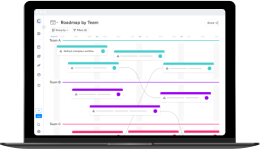
- Enterprise Portfolio and Product Portfolio Management views. craft.io has dedicated portfolio management features that give VPs and CPOs a consolidated view across product lines. Teams keep their own roadmaps and backlogs, but leadership can see everything in one place without asking for status updates.
- OKR alignment. The platform connects objectives to the features and initiatives each product team is working on. That connection makes it possible to see, at the portfolio level, which OKRs have work behind them and which are at risk because no team has picked them up.
- Dependency tracking. When one product team’s release depends on work from another team, those dependencies are visible in craft.io. That visibility moves dependency management from something that surfaces in a weekly standup into something leadership can monitor proactively.
- Actual vs. Planned reporting. The Actual vs. Planned feature tracks how roadmaps change over time, so you can see not just where things stand today, but how the plan has shifted and why.
- Capacity planning. Allocating engineering and product capacity across multiple teams is part of the portfolio manager’s job. craft.io includes capacity planning tools that make that allocation visible and adjustable.
The platform also connects to Jira and other delivery tools, so the roadmap view at the portfolio level stays in sync with what teams are actually building, rather than relying on manual updates.
The Business Case Your Approver Needs to See
If you are a Head of Product or VP making the case for portfolio management tooling to a CPO or CFO, the argument is straightforward. The cost of not having portfolio-level visibility is paid in three ways: wasted capacity from teams working at cross-purposes, delayed launches from unmanaged dependencies, and leadership time spent assembling reports that should be automatic.
A platform like craft.io addresses all three. Teams work in a shared system, so capacity and dependency information is already there when you need it. Reporting for executives is generated from live data, not assembled manually the night before the quarterly review. And when strategy changes, the impact on the portfolio is visible immediately, so you can make resourcing decisions with current information rather than week-old status updates.
For organizations running multiple product lines, the alternative is a patchwork of spreadsheets, presentation decks, and point tools that each capture part of the picture. The portfolio manager’s job in that environment becomes largely about information gathering rather than actual decision-making.
Where to Go from Here
If you are evaluating how craft.io fits your portfolio management needs, the Product Portfolio Management and Enterprise Portfolio platform pages cover the specific features in more detail. The CPO solutions page is also worth reviewing if you want to see how craft.io is positioned for executive-level product leadership.
For a broader look at what distinguishes portfolio management from individual product management, the knowledge base article on portfolio management vs. product management covers the key differences. And if your team is also working on how to structure a portfolio roadmap, the article on the benefits of a product portfolio roadmap is a useful starting point.