Product discovery tools: how teams collect ideas and decide what to build
Product discovery is the stretch of work between “someone had an idea” and “engineering starts building it.” Ideas arrive from customers, sales, support and the team itself. Without a shared place for them, they live in spreadsheets, chat threads and slide decks, and the loudest voice usually wins.
A product discovery tool gives that stretch of work one home. At craft.io we build our Discover and feedback capabilities for the product manager who already feels this pain and needs a repeatable way to decide what gets built. Below is how a discovery workflow runs, step by step, and what a tool needs to support at each one.
The discovery workflow, step by step
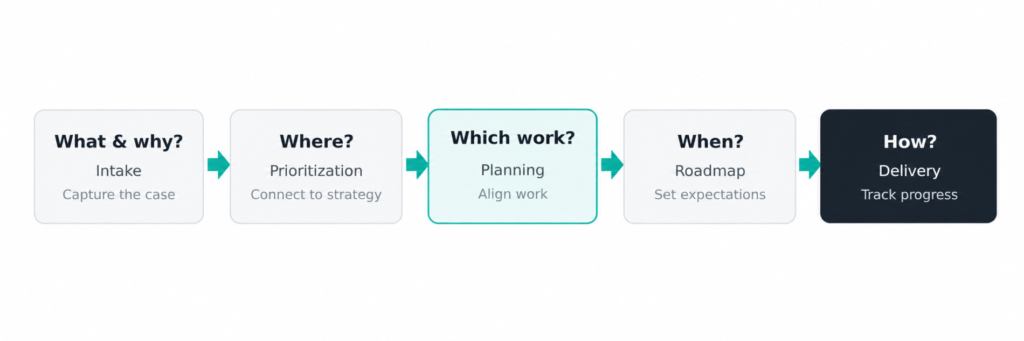
Whatever tool you use, the workflow tends to follow the same path from intake to decision.
- Idea intake. Ideas need a single entry point that anyone can use, and every idea needs a record. The tool should let you capture an idea in seconds and keep its source attached. For background on the discipline, see our page on idea management.
- Feedback. An idea alone says little. Feedback from customers and internal teams shows how many people want it and why. The tool should let you invite people to give feedback or sync existing data, then tie each piece of feedback back to the idea it supports. Our tips on managing customer feedback and managing feature requests cover this stage in more depth.
- Scoring. This is where opinions become comparable. The tool should support built-in prioritization frameworks so every idea is scored against the same criteria. Our guide on estimating the value of new product ideas shows how to think about it.
- Go/no-go decision. The output of discovery is a decision someone can defend. A tool should show the score, the supporting feedback and the link to company objectives side by side, so the call is made on evidence and the reasoning is recorded.
What the tool needs at each step
A short checklist you can hold any tool against:
- Intake: one place for ideas, with the source of each idea kept on the record.
- Feedback: ways to collect new input and bring in existing data, linked to specific ideas.
- Scoring: prioritization methods built in, so teams are not rebuilding scoring sheets by hand.
- Decision: a view that connects ideas to company objectives, so you can see which ones move a goal and which do not.
- Handoff: a path from an approved idea to defined features and a roadmap, so the decision does not die in a document.
The last item is the one teams most often miss. A discovery tool that cannot pass an approved idea forward leaves you copying work into another system. Before you buy, our product discovery tool checklist lists ten questions worth asking a vendor.
Standalone discovery tool or full platform
A standalone discovery tool does one job: it collects and ranks ideas. That can be enough for a small team with a simple process and a separate roadmap tool already in place. The cost shows up at the handoff. Approved ideas are re-entered somewhere else, and the link between the original feedback and the shipped feature gets lost.
A product management platform keeps discovery connected to the rest of the work. craft.io covers the full chain in one place: strategy, feedback, feature definition, prioritization, capacity planning, roadmap and execution. A feature on the roadmap can be traced back to the feedback and the score that put it there, and forward to the capacity of the teams who will build it.
Neither choice is right for everyone. If discovery is the only gap in your process, a focused tool may fit. If the same team also fights with disconnected roadmaps and prioritization sheets, a platform removes the handoffs. Teams comparing options can see how it all fits together on the platform page.
Where to start
Pick the step in your current process that breaks first. For many teams it is feedback, because requests sit in too many places to count. For others it is scoring, because every roadmap debate restarts from zero. Fix that step, then extend the same tool to the steps on either side.
You can see how craft.io handles idea intake and evaluation on the Discover page, and how it gathers and organizes user input on the feedback page.
Product discovery tools: common questions
What is a product discovery tool?
A product discovery tool gives product teams one place to collect ideas, gather feedback, score options and decide what to build. It replaces scattered spreadsheets, chat threads and slide decks.
What steps does a discovery workflow include?
A typical workflow runs from idea intake through feedback and scoring to a go/no-go decision. A good tool also passes approved ideas forward into feature definition and the roadmap.
Do I need a standalone discovery tool or a full platform?
A standalone tool can work if discovery is your only gap and you already have a separate roadmap tool. A platform removes the re-entry of approved ideas and keeps feedback linked to the features that ship.
Why does scoring matter in discovery?
Scoring makes ideas comparable by applying the same criteria to each one. It moves the decision from whoever argues loudest to evidence the team can defend.
What should I check before buying a discovery tool?
Check how it handles idea intake, feedback collection, built-in prioritization, the link to company objectives and the handoff to the roadmap. Our product discovery tool checklist lists ten questions to ask a vendor.