Product portfolio management software: what it should do and how to justify it
Most product organizations outgrow their tools before they admit it. One team keeps a roadmap in slides, another tracks initiatives in a spreadsheet, a third lives inside Jira. Then a leadership review arrives and someone spends a week stitching the pieces into one view that is already out of date.
Product portfolio management software exists to replace that stitching. It gives a VP Product or CPO one place to see every product, initiative and release, tied back to company objectives. That is the job. If a tool cannot show you how the work across several teams connects to strategy, it is a roadmap tool, not a portfolio tool.
Craft.io covers this on its product portfolio management platform page, and the larger multi-division version on the enterprise portfolio page.
The problems a portfolio tool solves
Before you ask for budget, name the specific problems you have. A purchase request that says “we need better visibility” rarely survives a finance review. These are the situations that usually justify the spend:
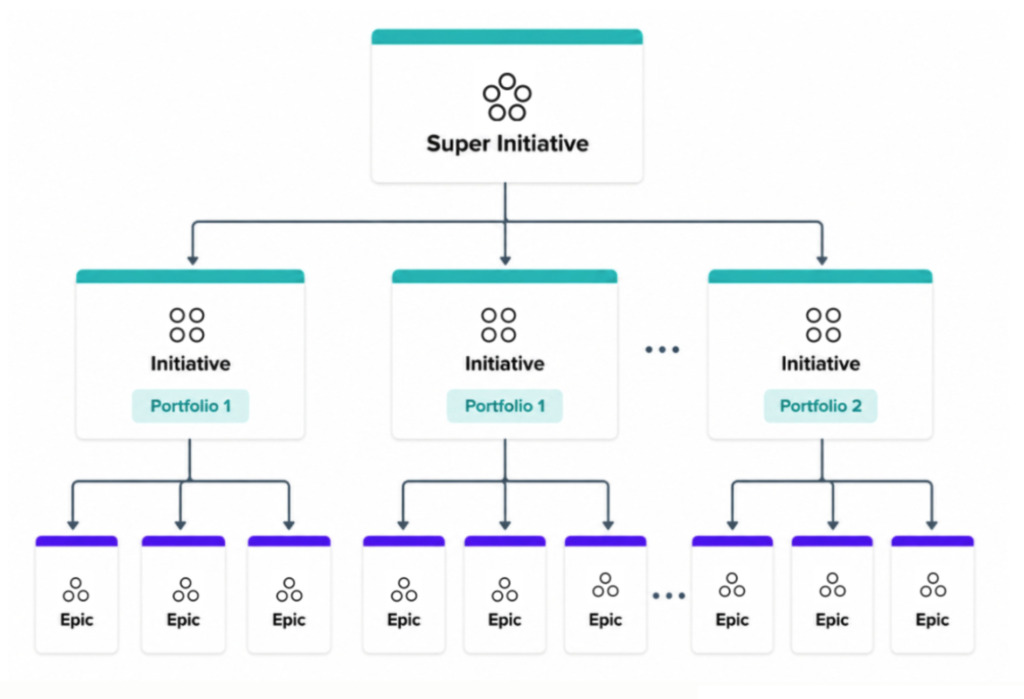
- Strategy and delivery are disconnected. Objectives live in one document and features live in another, so nobody can say which work moves which goal. Linking OKRs to initiatives, epics and features closes that gap.
- Prioritization differs team by team. Each team scores work its own way, so cross-team tradeoffs become arguments instead of decisions. A shared prioritization method fixes the argument.
- Capacity is guessed. Leaders commit to roadmaps without seeing what each team can actually take on.
- Reporting is manual. Spreadsheets become the source of truth, and they go stale the moment they are shared. We wrote about this in why spreadsheets undermine product management efforts.
- Plans drift without anyone noticing. When the roadmap changes, there is no record of what moved or why. Craft.io’s Actual vs Planned view tracks that change.
Questions to ask every vendor
Demos are built to look good. These questions are built to find the gaps, so ask them in the order that matters to your organization.
- Can I see several products and teams on one roadmap, then drill into a single initiative, without leaving the tool?
- How do objectives connect to the work? Show me an OKR linked down to a feature, and back up.
- Which prioritization frameworks are built in, and can different teams use the same one so scores are comparable?
- How does capacity planning work, and does it reflect real team availability?
- How does it sync with our delivery tools? Walk me through a two-way sync with Jira.
- What reporting can leadership use without asking a product manager to build it?
- How are permissions handled across divisions, and what does your data security documentation cover?
- What does rollout look like, and who from your side supports it?
A vendor that answers every question with a slide instead of a live screen has told you something useful.
How to frame the case internally
The strongest business case uses your own organization’s evidence, not industry statistics you cannot defend. Do not quote a number you cannot trace to a source. A finance partner will ask where it came from, and one weak figure undermines the rest.
Build the case from four things you can verify yourself:
- Time spent today. Ask your product managers how many hours a month go to assembling roadmap decks and status reports. Use their numbers, labeled as estimates.
- Decisions that went wrong. Point to a recent initiative that shipped late or missed its goal because teams were not aligned, and trace what a shared view would have changed.
- Tool sprawl. List what you pay for now: slide tools, spreadsheets, add-ons. Some of that spend may be replaceable.
- Risk of staying put. Describe what happens at the next planning cycle if the process stays as it is.
Then state the ask plainly: what you want to buy, who will use it, what you will measure after the first quarter, and when you will report back. A modest, measurable proposal is easier to approve than a promise of transformation.
If you want a second angle, our page on the benefits of a product portfolio roadmap and the difference between product management and portfolio management can help you explain the category to stakeholders who are new to it.
Where to go from here
Start by writing down the three problems from the list above that your organization feels most. Take those to your vendor demos instead of a generic feature checklist. If you want to see how craft.io handles them, the CPO solutions page and the product portfolio managers page describe the workflow, and the pricing page shows how plans are structured.
Frequently asked questions
What is product portfolio management software?
It is software that gives product leaders one view of every product, initiative and release across teams, connected to company objectives. It goes beyond a single team roadmap by supporting prioritization, capacity planning and reporting across the whole portfolio.
How is portfolio management different from product management?
Product management focuses on one product and its roadmap, while portfolio management looks across several products to balance priorities and resources. Craft.io has a separate page explaining the differences in more detail.
Who usually approves the purchase of a portfolio tool?
Typically a Head of Product, VP Product, CPO or product ops lead. They usually need a clear business case showing the problems the tool solves and how success will be measured.
How do I justify the cost without industry statistics?
Use evidence from your own organization: hours spent building reports, initiatives that slipped from misalignment, and the cost of the tools you want to replace. Label estimates as estimates so finance can trust the rest.
Should a portfolio tool connect to Jira?
Yes, it should connect to your delivery tools so roadmap and execution stay in sync. Ask vendors to show the sync live rather than describing it on a slide.
What should I ask a vendor during a demo?
Ask to see several products on one roadmap, an objective linked down to a feature, how capacity planning works, how teams share a prioritization method, and what leadership reporting looks like without manual work.