OKR software for product teams: connecting objectives to features and roadmaps
Why product teams need OKRs tied to the work
Most OKR tools are built for the whole company. They track objectives and key results well, but they sit apart from the place where product teams decide what to build. The result is a familiar gap: leadership sets objectives, the team keeps a backlog, and nobody can say which features move which key result.
OKR software for product teams closes that gap. The goal is not a prettier scorecard. It is a direct, visible line from an objective to the initiatives, epics and features that are meant to deliver it.
How to link OKRs to initiatives and features
The mechanics are simple, but they only work if the links are kept in the same system as the work itself. A practical way to structure it:
- Start with a company or business-unit objective, written as an outcome rather than a task.
- Attach key results that can be measured, so progress is a number and not an opinion.
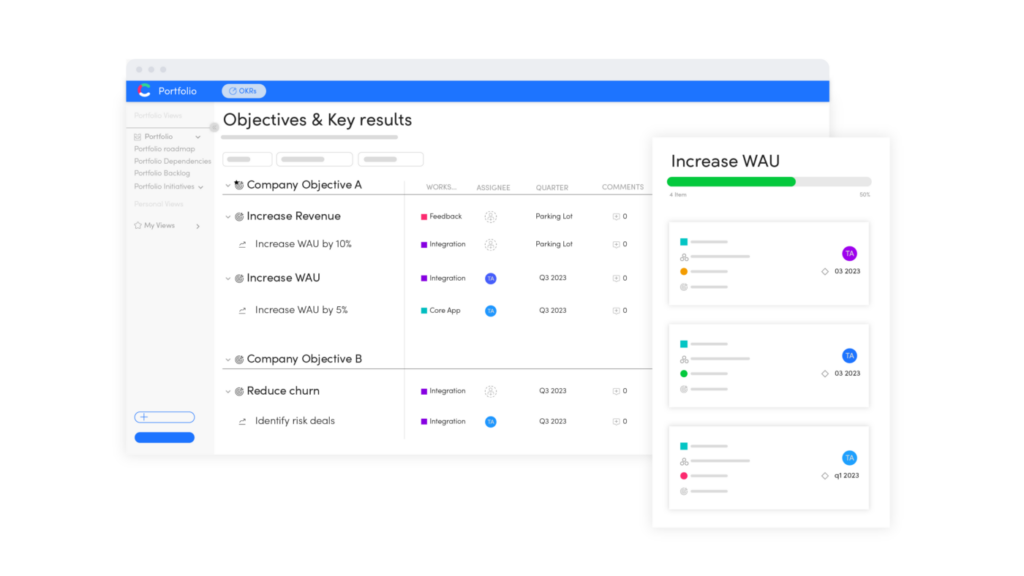
- Link each key result to the initiatives you believe will move it.
- Break initiatives into epics and features, so every piece of delivery work traces back up to an objective.
With craft.io you can link OKRs to initiatives, epics and features, then see which features help reach company objectives. When a feature has no objective above it, that is worth a conversation before it takes up capacity.
What to look for in OKR software
If you are comparing tools, judge them on how well they connect strategy to delivery, not on how many OKR templates they ship. Questions worth asking:
- Can objectives be linked directly to initiatives, epics and features, or only to other objectives?
- Does the tool sit in the same place as your backlog, prioritization and roadmap, or is it a separate silo?
- Can you build roadmaps and dashboards that are organized by objective?
- Can teams at different levels see how their objectives roll up to the company’s?
- Does it connect to the delivery tools your engineers already use?
A standalone OKR tracker tends to go stale because updating it is extra work. When OKRs live next to the roadmap and the backlog, they get updated as part of normal planning.
How OKR-based roadmaps work in practice
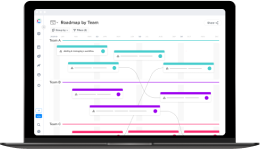
A traditional roadmap is organized by feature or by date. An OKR-based roadmap is organized by the objective each piece of work serves. That changes the conversation with stakeholders. Instead of defending a list of features, you show which objective a group of features supports and how close that objective is to its key results.
In practice this helps in a few places:
- Prioritization: work that supports a current objective rises, and work with no clear link gets questioned.
- Stakeholder updates: a dashboard grouped by objective answers the question of why something is on the roadmap without a separate deck.
- Trade-offs: when capacity is tight, you can see which objective a cut would affect.
craft.io supports OKR-based roadmaps and dashboards for exactly this kind of visualization, so the roadmap and the objectives stay in sync.
Getting started
Begin small. Pick one objective for one product team, attach a few measurable key results, and link the initiatives already in flight. Once the links exist, gaps show up quickly: features with no objective, and objectives with no work behind them.
To see how this works in craft.io, read about the OKR software platform for product management. For ongoing tracking, the post on keeping the team on track with OKR tracking software covers the follow-through, and the roadmap page shows how strategy connects to features.
OKR software for product teams: FAQ
What is OKR software for product teams?
It is software that lets product teams set objectives and key results and link them directly to initiatives, epics and features. The aim is to see which delivery work supports which objective, rather than tracking OKRs in isolation.
How do you link OKRs to features?
Start with an objective and its key results, link the initiatives expected to move them, then break those into epics and features. In craft.io you can link OKRs to initiatives, epics and features so every feature traces back to an objective.
What is an OKR-based roadmap?
It is a roadmap organized by the objective each piece of work serves, instead of by feature or date. It makes it easier to show stakeholders why something is on the roadmap and how close each objective is to its key results.
How is product-team OKR software different from a company-wide OKR tool?
A company-wide tool focuses on tracking objectives across the organization. Product-team software keeps OKRs next to the backlog, prioritization and roadmap, so objectives connect to the features that deliver them.
What should I look for when choosing OKR software?
Check whether objectives link to initiatives, epics and features, whether the tool sits alongside your roadmap and backlog, and whether it offers OKR-based roadmaps and dashboards. Also check that it connects to your delivery tools.